MiraCosta College Classified Union

A Stronger Voice for Classified Professionals

MiraCosta Classified Professionals are ready for a serious conversation about union representation, stronger bargaining, and a fairer workplace.

Classified Professionals Have Spoken

57% support union representation.

Another 26% are neutral or unsure.

The message is clear: Classified Professionals want a real conversation about stronger representation. Many employees already support forming a union. Others want accurate information before deciding. We heard you. That is what this site is here to provide.

57%

Support union representation

Strongly or somewhat support forming a Classified union.

26%

Neutral or unsure

Many employees said they want more information before deciding.

Source: MiraCosta Classified Senate Representation & Advocacy Survey, conducted April 27–May 11, 2026. The survey was anonymous. The union-openness question had 197 valid responses from Classified Professionals.

Upcoming Union Information Sessions

American Federation of Teachers (AFT), Thursday, August 13

Times: 11:30 a.m.–12:30 p.m. and 1:00–2:00 p.m.

In person: Oceanside Campus, Student Services Building 14, Room 14180

Online: Join via Zoom

Lunch will be provided.

Representatives from the American Federation of Teachers (AFT) will be available to explain their organization, answer questions, and discuss what AFT representation could look like for MiraCosta classified employees. AFT is a national union that also represents classified professionals at many institutions. It is a different union than the California School Employees Association (CSEA) that met with us on campus in July.

Please attend only during your scheduled lunch or break period. Additional materials will be shared after the sessions.

Why a Union and Why Now?

MiraCosta Classified Professionals are the only California Community College classified staff without a union.

We depend on the existing governance and meet-and-confer system for decisions involving pay and working conditions. A union would give eligible Classified Professionals a legally recognized bargaining representative and a direct voice in negotiations.

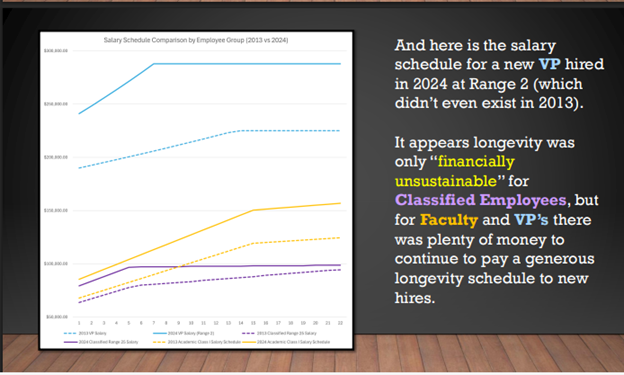
The post-2018 pay system is not sustainable

Employees hired after 2018 are placed on a five-step salary schedule. After reaching the final step, regular salary progression stops and employees only get COLAs and small one-time cash payments that don't add to their base salary. This creates a serious retention problem and treats employees doing comparable work very differently based on hire date.

View the salary comparison

This graph illustrates how the post-2018 Classified salary structure falls behind the progression available to other employee groups.

Salary comparison graph

View the Salary Schedule Presentation

Another classification and compensation study is here

The last major study created the current two-tier compensation system. During the current study, Classified Professionals need independent expertise, research, and representation. A union would put professional advocates on our side of the table instead of leaving employees to navigate the process alone.

What Employees Want From a Union

Employees were not asking for a union simply to have a union. They identified practical improvements that collective bargaining could provide.

76% want stronger negotiating power

A union-backed team focused on compensation, COLA, longevity, classification, benefits, and working conditions.

“Stronger negotiations: We are at a disadvantage compared to the district, as we do not have the same level of legal expertise or depth of knowledge regarding labor laws and regulations. As a result, negotiation outcomes often favor the district when we engage directly.”

Survey respondent

55% want better working conditions

Including workload, out-of-class work, scheduling, flexibility, and workplace fairness.

“Teleworking for eligible employees to support work-life balance. COLA. Longevity.”

Survey respondent

54% want stronger advocacy

Representation that recognizes the varied work and roles of Classified Professionals.

“Advocating for staff needs, fostering professional development and keeping all staff in the loop about what is happening”

Survey respondent

52% want fairer and more consistent policies

Clearer, more transparent, and more equitable application of workplace rules and processes.

“Ensuring the Class and Comp study is done fairly and effectively. Ensuring that Classified are appropriately represented in the various spaces and conversations.”

Survey respondent

Nearly twice as many employees said the current system does not adequately represent their interests as said it does.

44% disagreed that the current system adequately represents them, compared with only 25% who agreed.

Questions People Are Asking

What Would Union Dues Actually Cost?

Dues cost was the number one concern reported in the recent MiraCosta Classified employee survey. That makes the structure of the dues, not just the stated percentage, important. Organizers are talking with two unions and holding information sessions for employees to ask questions and compare them before anything is final. The main difference: CSEA dues have an annual cap, while the AFT continues to increase with salary.

CSEA: a capped annual maximum

$500/year Estimated maximum, includes estimated 2.75 local dues

CSEA state dues stop increasing once the annual cap is reached. Under the assumptions used here, the maximum deduction would be $50 in each of 10 paid months.

AFT Guild: percentage of all gross pay

1.5% + $2.75 Of gross pay, 2.75 is estimated monthly local dues to support the MCC unit

Under the published San Diego AFT Guild example, dues continue increasing as salary increases because the percentage applies to all gross pay. This comparison adds the same assumed $2.75 in local dues each month.

Estimated annual and payroll-period dues at representative salary levels
Annual salary AFT monthly
(12 months)
AFT annual CSEA deduction
(10 months)
CSEA annual Annual savings
with CSEA
$30,000 $40.25 $483.00 $40.25 $402.50 $80.50
$50,000 $65.25 $783.00 $50.00 $500.00 $283.00
$80,000 $102.75 $1,233.00 $50.00 $500.00 $733.00
$100,000 $127.75 $1,533.00 $50.00 $500.00 $1,033.00
$120,000 $152.75 $1,833.00 $50.00 $500.00 $1,333.00
The practical difference: CSEA's cap makes the cost more predictable. At an $80,000 annual salary, the estimated CSEA total would be $500 per year, which is $733 less than the AFT Guild example after including the same assumed local dues. At $100,000, the estimated difference would be $1,033 per year.

Dues would not begin merely because someone signs a card. They would apply only after employees vote to unionize and a chapter is formed.

Assumptions: Salary is paid over 12 months. CSEA figures assume 10 payroll deductions per year and $2.75 in local dues per deduction. The AFT comparison assumes 1.5% of gross pay over 12 paid months, plus the same $2.75 in local dues for each of the 12 deductions. The $21 minimum does not affect the salary examples shown.

CSEA source: CSEA states that annual state dues are 1.5% of the first $3,150 of monthly gross salary, capped at $472.50 annually. Local chapters may assess additional dues. View the CSEA dues information.

AFT comparison source: A published SDCCD AFT Guild membership packet states dues of 1.5% of gross pay, with a $21 minimum, for each month in paid status. This comparison is illustrative and is not a dues quote for MiraCosta employees. View the SDCCD membership packet.

Dues rates and local assessments can change. Confirm the final structure with each union before an election or formal membership campaign.

Who is CSEA?

The California School Employees Association is a member-run union representing non-teaching public-school and community-college employees throughout California. CSEA provides negotiators, research, training, organizing support, and legal assistance.

Who is AFT?

The American Federation of Teachers is a national union representing educators, higher-education faculty and professional staff, paraprofessionals and other school-related personnel, public employees, and healthcare workers. In San Diego County, AFT Guild Local 1931 is a member-driven affiliate representing community-college classified professionals, faculty, and hourly workers. AFT provides bargaining, organizing, research, training, and legal support.

Who would represent us?

MiraCosta Classified Professionals would form their own local chapter and elect their own officers and stewards. CSEA would provide professional support, but the local chapter would be run by MiraCosta employees.

What would happen to the Classified Senate?

A union and the Classified Senate serve different purposes. The Senate participates in shared governance and campus decision-making. A union bargains over wages, hours, benefits, and working conditions and enforces the resulting contract. Both can continue to serve Classified Professionals.

I was hired before 2018. Why should I support a union?

A union protects existing compensation and benefits while giving all employees a stronger voice in future negotiations. The goal is not to take longevity away from pre-2018 employees. It is to protect what employees have earned and improve the system for those who were left behind.

I was hired after 2018. Why should I support a union?

The five-step salary schedule sharply limits long-term salary growth. A union could bargain for additional steps, stronger longevity payments, better benefits, or other improvements that recognize continued service.

What happens next?

Organizers are collecting signed union cards. If enough eligible employees sign cards, the process can move toward formal recognition or an official vote. If employees choose union representation, MiraCosta Classified Professionals will form a chapter, elect local leadership, identify bargaining priorities, and negotiate a first contract.

Do I have the right to ask questions or participate?

Yes. Eligible non-supervisory Classified Professionals have the right to form, join, participate in, or decline to participate in employee organizations. Employers may not interfere with or retaliate against employees for exercising those rights.

Asking questions does not commit you to a position. Supporting a union, opposing it, remaining undecided, and seeking information are all protected choices.

Ready to Take the Next Step?

Learn more, ask questions, and help build a stronger voice for MiraCosta Classified Professionals.

Completed cards must be physically signed and returned to an organizer. Email [email protected] to arrange pickup or drop-off.